
Align IT With Business Direction

IT Strategy & Planning

IT strategy and planning gives leadership a path to align systems, budgets, risks, and transformation decisions with growth.

Assess Your Current Technology Estate

Before recommendations are made, ENTMatrix, Inc. evaluates the systems, workflows, vendors, dependencies, and decision bottlenecks shaping your IT strategy and planning. This review highlights where technology is enabling progress, where costs are escalating, and where operational complexity is limiting speed, resilience, or future change across business units today and tomorrow.

KEY DECISIONS

What Should Leadership Clarify First?

IT strategy and planning begin with leadership decisions on business direction, investment discipline, risk appetite, and organizational readiness for change.

Business Drivers

We connect growth objectives, operating pressures, and stakeholder expectations to the decisions that matter most.

Risk Exposure

We surface security, dependency, and governance concerns that delay execution, increase exposure, or weaken resilience.

Spend Priorities

We compare initiatives by expected value, urgency, and cost impact so that investment supports business outcomes.

Change Readiness

We gauge timing, sponsorship, and capacity so efforts begin when the organization can sustain them.

PLANNING FRAMEWORK

How Do You Build an IT Strategic Plan?

A practical IT strategic plan turns strategic decisions into accountable actions, sequencing investments, governance, ownership, and review disciplines for execution.

Vision Alignment

We define future direction, decision principles, and enterprise intent so the IT strategic plan reflects business priorities clearly and consistently.

Budget Logic

We organize investment expectations around timing, outcomes, and ownership so spending decisions support growth without creating avoidable waste or duplication.

Governance Model

We assign roles, checkpoints, and escalation paths so execution stays visible, disciplined, and responsive as business conditions change over time.

Architecture Path

We outline how platforms, integrations, and controls should evolve so modernization improves capability without increasing fragmentation across systems or complexity.

Resource Mapping

We map internal capacity, partner support, and specialist needs so delivery remains realistic from planning through execution stages and governance.

Review Cadence

We establish checkpoints for measurement, review, and adjustment so the IT strategic plan stays relevant as priorities shift over time.
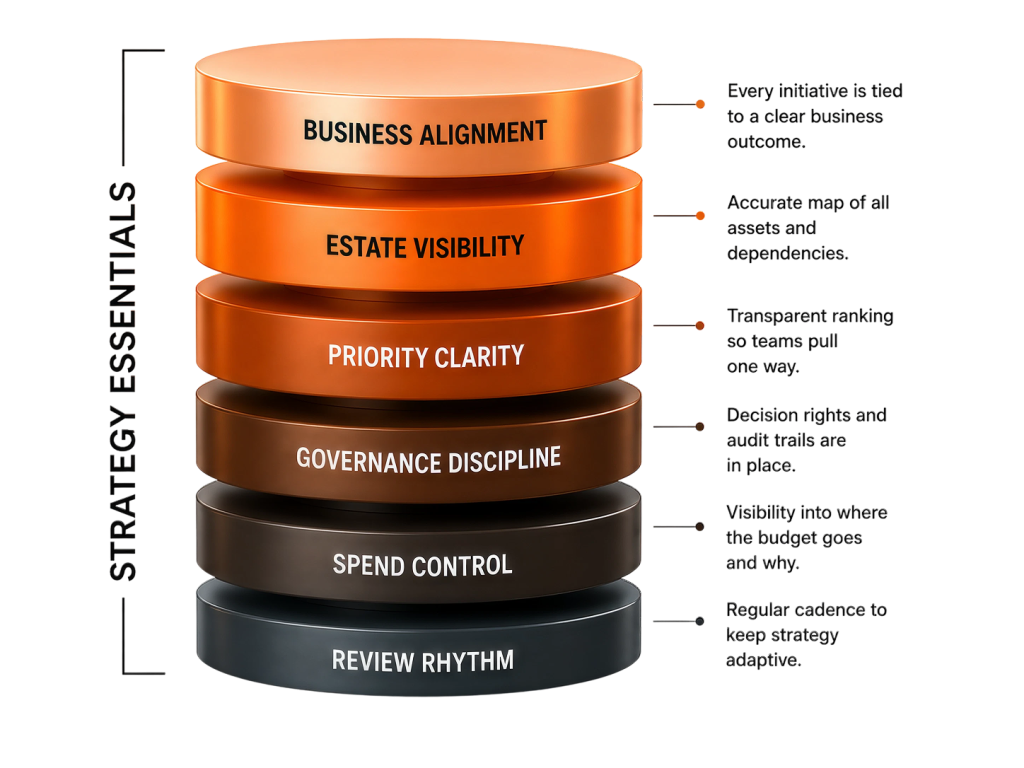
STRATEGY ESSENTIALS

Move From Intent to Measurable Outcomes

Six disciplines that transform IT strategy from aspiration into repeatable, measurable results.

Control Cost Without Slowing Growth

Effective IT strategy and planning does more than contain budgets. It helps leaders reduce duplication, retire low-value tools, improve vendor decisions, and sequence investments with clearer business logic. ENTMatrix, Inc. applies IT cost saving strategies that protect operational performance, support modernization, and keep growth initiatives from being undermined by preventable spending.

STRATEGY ESSENTIALS

What Keeps IT Strategy Effective?

Learn More ↗

Business Alignment

Estate Visibility

Priority Clarity

Governance Discipline

Spend Control

Review Rhythm

How ENTMatrix, Inc. Delivers Strategy

ENTMatrix, Inc. approaches IT strategy and planning through structured discovery, leadership workshops, governance modeling, and strategic IT consulting services tied to measurable execution outcomes consistently.

FAQs

What does this service typically cover?

IT strategy and planning usually begins with understanding business goals, current systems, risks, spending patterns, and delivery constraints. From there, ENTMatrix, Inc. identifies what needs attention now, what can wait, and what should be phased out. The outcome is a decision-ready direction that leadership can use to prioritize investments and guide execution.

A business should review its IT strategy and planning whenever growth plans change, costs rise, systems become harder to support, security expectations increase, or major initiatives are approaching. Regular reviews help leadership keep IT planning aligned with real operating conditions instead of relying on assumptions that no longer reflect business priorities.

Cost control starts with understanding value, not simply reducing spend. In IT strategy and planning, ENTMatrix, Inc. examines duplicate tools, underused licenses, legacy support burdens, vendor overlap, and deferred modernization. That is how IT cost saving strategies become practical decisions that protect continuity, reduce waste, and preserve room for growth.

Yes. IT strategy and planning should account for the full technology estate, including legacy systems, cloud platforms, integrations, data dependencies, and security controls. ENTMatrix, Inc. uses strategic IT consulting services to decide what should be retained, modernized, integrated, or retired so that change happens with less disruption and stronger business alignment.

The strongest outcomes come when business leaders, IT owners, finance stakeholders, security teams, and operational heads contribute early. IT strategy and planning are most effective when priorities are discussed across functions, because IT planning decisions affect budgets, risk exposure, customer experience, and delivery capacity at the same time.

After the IT strategy and planning are approved, the next step is turning decisions into governed action. That usually includes sequencing initiatives, assigning ownership, confirming budgets, setting review checkpoints, and tracking outcomes. ENTMatrix, Inc. supports that transition so the strategy becomes an active operating guide rather than a document that sits unused.